
What Do I Need to Know About the New Visa Interchange Rates in Canada?
Visa is changing several domestic credit interchange rates in Canada on October 24, 2026.
Several consumer interchange rates are decreasing, while the rate on the standard Visa Business Credit card is increasing.
But whether your business actually saves money will depend mainly on the types of Visa transactions you process and how your payment processor prices your account.
Businesses using interchange-plus pricing should immediately see the effects of these interchange rate reductions on their statements, but businesses that choose other pricing structures, like flat rate pricing, may not see these reductions reflected in their processing costs at all.
In any case, after the new rates take effect, you should review any notices from your processor and take a hard look at your statements so you can see if these changes are affecting what you pay.
Key Takeaways:
- Several Visa consumer credit interchange rates are decreasing.
- The standard Visa Business Credit rate is increasing from 2.00% to 2.15%.
- Your pricing structure can affect whether these changes will reduce your processing costs.
- You should review your notices and statements after October 24 to see how the changes affect your business.
- The impact on your business will depend on whether the Visa transactions you’re processing qualify for the affected rates.
If your business accepts Visa, there’s an important pricing change coming this fall.
Effective October 24, 2026, Visa is changing several domestic credit interchange rates in Canada.
A number of consumer interchange rates are being reduced, while the standard Visa Business Credit rate is increasing.
At first glance, that sounds like good news for many business owners. Because if an interchange rate goes down, your payment processing costs should go down too, right?
Possibly. But the answer depends on the kinds of cards your customers use, what Visa transactions your business processes, whether these interchange rate changes apply to those transactions, and how your payment processor prices your account.
And that last point matters more than many business owners realize.
So, rather than simply listing the new Visa interchange rates in Canada, we want to explain what these changes could mean for your actual processing costs, how to tell whether you’re benefiting from a reduction, and what to look for on your statements once the new rates take effect.
What Visa Interchange Rates Are Changing on October 24?
Visa’s October update includes reductions to a number of selected domestic consumer credit interchange rates.
For example, the Small Merchant Electronic rate for Core Credit cards, including Classic, Gold and Platinum, will drop from 0.77% to 0.70%, and the Small Merchant Card Not Present rate for those cards will move from 1.30% to 1.20%.
For Visa Infinite Credit, the Small Merchant Electronic rate is changing from 0.99% to 0.89%, while the Small Merchant Card Not Present rate will move from 1.55% to 1.45%.
What’s more, several Visa Infinite+, Visa Infinite Privilege, and industry-specific rates are also being reduced.
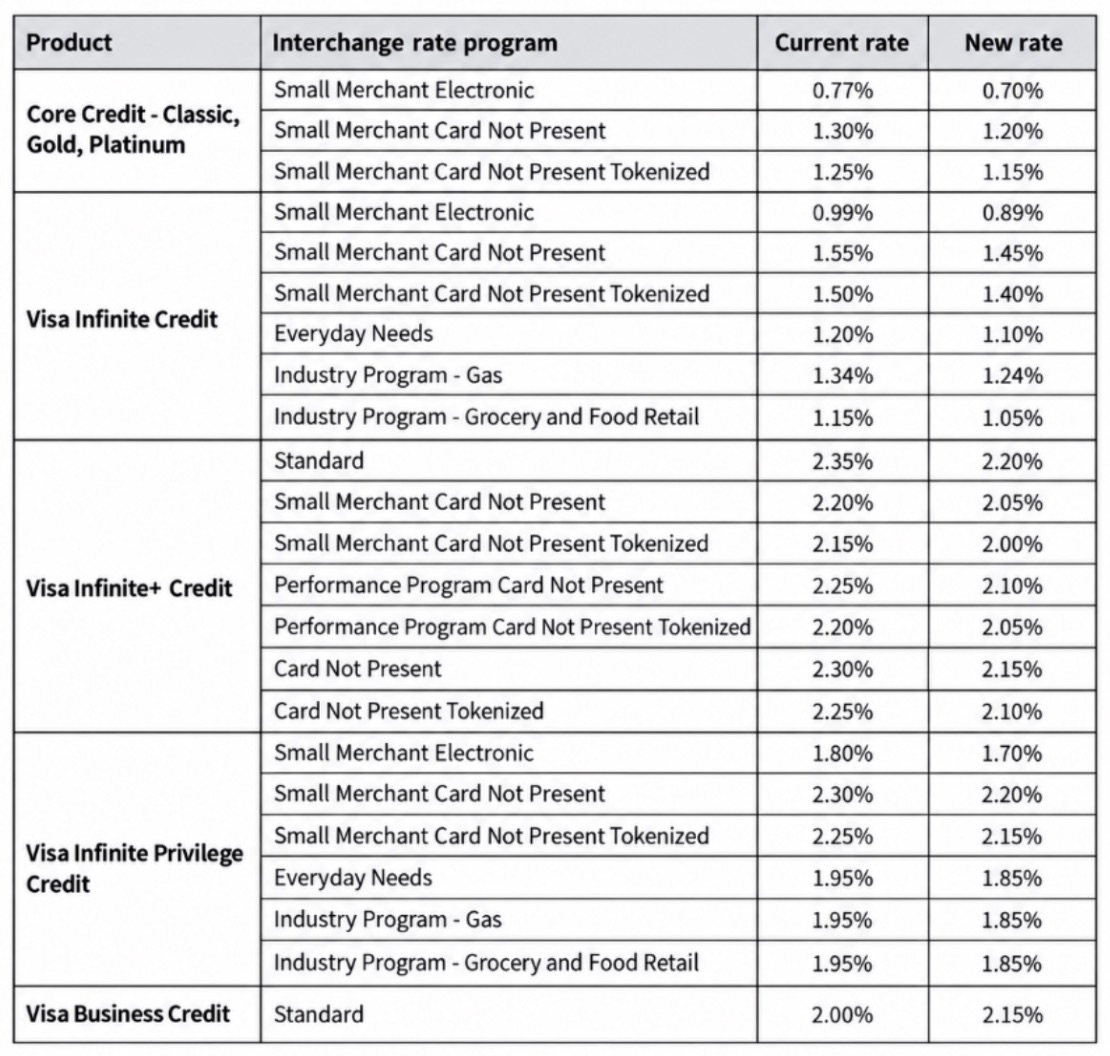
Visa interchange rate changes for October 24, 2026. Source data: Moneris.
However, not every rate is going down. As you can see from the table above, the standard Visa Business Credit interchange rate is increasing from 2.00% to 2.15%.
And that’s an important distinction, as this doesn’t represent a blanket reduction across every single Visa transaction.
Most of the interchange rates on these cards are being reduced, but the effect on individual businesses will depend on several factors, including what cards your customers use, the rate changes those transactions qualify for, and what pricing structure you’ve chosen.
A Quick Refresher: What Is an Interchange Rate?

Interchange is one component of the cost involved in accepting a card payment.
Visa describes interchange as the transfer rate between the merchant’s financial institution, known as the acquirer, and the cardholder’s financial institution, known as the issuer.
At any rate, Visa sets default interchange rates in Canada, and different transactions can qualify for different rates.
And that’s why there’s no single Visa interchange rate that applies to every sale.
The type of card affects this rate, but so does the way the payment is accepted.
A card-present transaction, for instance, will have a different rate from an online or other card-not-present transaction.
All things considered, interchange is only one part of what you ultimately pay your processor, and that’s one reason why a published rate reduction doesn’t automatically tell you what will happen to your total processing bill.
If you want more information on interchange rates, you can read our article, What You Need to Know About Interchange Rates in Canada, which explains this in much greater detail.
How Much Difference Can a 0.10% Reduction Really Make?
When you look at the new rate table, some of the changes may not seem especially dramatic.
A move from 1.30% to 1.20%, for example, is a difference of only 0.10 percentage points.
But processing costs are a volume game, and that means a small percentage can become meaningful when it’s applied across a large amount of transactions.
For example, imagine $100,000 in monthly card volume was subject to a rate that dropped by 0.10 percentage points. That represents a difference of $100 per month, or $1,200 per year.
And at $200,000 per month, the same difference would equal $200 per month, or $2,400 per year.
In any case, a tenth of a percentage point may look insignificant, but when you apply it to the processing volume of an established business, it can make a huge difference.
So, Will Your Business Actually Pay Less?
This is where your pricing model becomes especially important.
A Visa interchange reduction changes one of the underlying costs associated with processing a transaction. But your final cost is determined by several things, including the pricing arrangement you have with your processor.
With interchange-plus pricing, the structure is relatively straightforward. You pay the applicable interchange cost, plus the processor’s stated markup.
So, if the interchange rate on a qualifying transaction falls, the underlying interchange portion of that transaction falls with it. And this makes it much easier to see how a rate change affects what you’re paying.
That transparency, which allows for the interchange rate to be separated from the processor markup and makes it easier for business owners to see what they’re paying, is the main reason why we prefer interchange-plus pricing.
Flat-rate or blended pricing, on the other hand, works differently. Typically, rather than seeing the applicable interchange rate plus a separate processor markup, you’ll pay one combined rate across many different card and transaction types.
That can make your monthly costs easier to predict, but it can also make it harder to see what effect a particular rate change has had on how much you’re paying.
The real takeaway here is that a reduction in the underlying interchange rate won’t necessarily show up on your bill in the same obvious way under every pricing structure.
If you want to learn more about interchange-plus pricing, and how it can benefit your business, you can read our article on Why Interchange Plus Pricing Is the Best Way to Pay for Payment Processing.
What If an Applicable Reduction Isn’t Passed Along in Full?

Canadian business owners have specific protections under the Code of Conduct for the Payment Card Industry in Canada.
Under the Code, processors must notify merchants between 30 and 60 calendar days before certain fee changes take effect. And that includes applicable domestic core-fee reductions that will not be passed along to the merchant in full.
The notice must explain the previous and new amounts, who is making the change, and how much of the change will be passed on to the merchant.
Depending on the circumstances, the Code also gives businesses the right to provide notice that they intend to exit their payment processing agreement without penalty within 70 calendar days after the applicable fee change takes effect.
However, if Visa reduces a rate for a program that none of your transactions qualify for, then that reduction doesn’t apply to your business, and the Code doesn’t require a processor to pass along a reduction for a rate program your transactions never use.
All things considered, this is a great example of the importance of understanding the terms of your pricing structure, what’s actually showing up on your statement, and what applies to your business.
What Should You Check on Your Next Processing Statement?
Once the new Visa interchange rates in Canada take effect, there are a few things worth reviewing.
First, you should make sure you know how your account is priced.
If you’re not sure whether you’re on interchange-plus, flat-rate, blended or another pricing structure, ask your processor.
Because you can’t properly evaluate a rate change if you don’t know how your pricing works.
Then you should review any notice your processor sends about the October changes. And if an applicable reduction isn’t being applied in full, the notice should give you information about why exactly that is.
Next, you should compare your processing statements after October 24 with previous statements.
You’re not looking for one universal percentage decrease because the result will depend on the kinds of cards your customers use and the types of transactions you process, among other things.
Instead, you should look at the Visa rates and fees that apply to the transactions you actually process.
And if the numbers don’t make sense, you should ask for an explanation.
Why You Still Need to Check Your Own Numbers
For many Canadian merchants, some of the Visa changes taking effect on October 24 could mean lower interchange costs on qualifying transactions.
Unfortunately, there’s no single answer to the question, “How much will my business save?”
The answer to that question will be determined by the kinds of cards your customers use, the types of transactions you process, and your pricing structure.
And in some cases, an interchange rate may actually be increasing rather than decreasing.
But at the end of the day, the best approach is to treat these upcoming changes as a reason to take a closer look at your payment processing costs.
You might be surprised at what you find.
Lower interchange rates can only help if the savings actually reach your business.
If you’re not sure how recent changes will affect your costs, contact Lucid Payments to take a closer look.

